

Why Choose Plastic Cloth Hangers?
plastic cloth hangers are widely used in retail stores, laundries, garment factories, and homes because they balance practical performance with cost control and consistent supply. For many buyers, the main goal is not only to hang clothing, but to keep garments looking organized, reduce deformation during storage, and maintain a clean display standard across a large number of items. When chosen correctly, plastic hangers support daily operations by improving sorting efficiency, speeding up garment handling, and keeping clothing presentation consistent from rack to rack.
Jinshunda focuses on plastic-made hanger solutions across two core ranges: Adult Plastic Hangers and Child Hangers. Our products cover broad size needs and multiple styles, allowing buyers to match hanger structures to garment categories rather than forcing one hanger to fit everything.
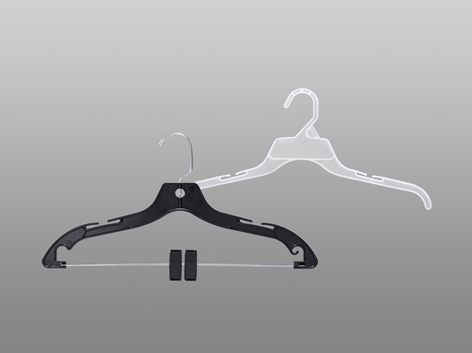
Plastic hangers make daily handling faster and more consistent
In real operations, hangers are handled repeatedly. They are moved from receiving areas to racks, from racks to fitting rooms, from fitting rooms back to racks, and then into packaging or laundry workflows. Plastic hangers are often chosen because they are lightweight, easy to grip, and simple to transport in bulk. This reduces staff fatigue and shortens the time needed to sort and reset displays.
Plastic hangers also support consistent presentation. When a store or facility uses the same hanger family across departments, the rail line looks cleaner, spacing stays uniform, and garments align better. This is especially important in commercial settings where hangers are part of the visual standard rather than an afterthought.
A wider size span helps match hangers to real garment dimensions
A key reason buyers select plastic hanger suppliers with multiple size options is fit control. Hanger size affects shoulder support, garment drape, and how clothing sits on racks. If the hanger is too wide, it stretches shoulder seams. If it is too narrow, garments slide and lose shape.
Jinshunda’s plastic hangers cover a clear size span from 8 inches to 19 inches, supporting both children’s and adult clothing. In general use, 8 to 10 inches are commonly selected for children’s garments, while 15 to 19 inches match most adult apparel display and storage needs.
This size structure makes it easier for buyers to standardize procurement while still ensuring correct fit for different product lines.
Plastic hanger styles can be selected by garment type, not guesswork
Plastic hangers are often misunderstood as a single category, but practical usage depends heavily on style. Different garments require different support points, friction behavior, and hanging posture. Jinshunda offers multiple plastic hanger styles to fit specific garment needs, including standard hangers, trouser hangers, underwear hangers, suit hangers, set hangers, and one-piece hangers.
Standard plastic hangers are the baseline option for daily garments such as T-shirts, shirts, and knitwear. Smooth surfaces help reduce fabric snagging and support clean, repeatable storage.
plastic trouser hangers are designed for flat hanging, often with anti-slip grooves or clamping structures to reduce creases and keep trouser legs aligned.
Suit hangers focus on shoulder support. A wider shoulder structure helps maintain suit shape and reduces shoulder deformation during longer storage periods.
One-piece hangers help keep top and bottom garments together, supporting complete outfit display and reducing pairing errors during merchandising.
Set hangers improve classification efficiency by offering coordinated solutions for tops, pants, and skirts, which reduces picking time in stores and warehouses.
Underwear hangers are designed for small items with multi-clip or partition structures, improving organized display for high-SKU categories.
For buyers, the benefit is straightforward: selecting the correct plastic hanger style reduces garment damage, improves rack organization, and strengthens display consistency.
Plastic hangers support stable large-scale supply for commercial operations
For B2B procurement, product performance is only half the requirement. The other half is supply stability. Commercial buyers often need repeat orders that match the same shape, size, and hanging posture across seasons. Plastic hangers are well-suited for this because the manufacturing process supports consistent replication and reliable batch output.
Jinshunda’s production flow is built around injection molding and structured quality inspection. Plastic granules are heated, melted, and injected under pressure into precise hanger molds, then cooled and released to form the hanger body. Each newly formed hanger is inspected for appearance issues such as flash, bubbles, or deformation, and dimensions are measured to ensure consistency before moving forward.
This process focus helps buyers maintain consistent hanger specifications across long-term procurement cycles.
Metal hook insertion improves usability and daily load handling
For many commercial environments, the hook is the highest-use point. It must remain stable through repeated rotation, frequent rail movement, and continuous hanging and removal. In Jinshunda’s workflow, hook insertion is handled through an automated insertion process with precise positioning and detection.
After injection molding and initial inspection, hangers enter an automatic hook insertion stage. The machine positions the hanger, feeds hooks in order, and inserts them quickly and accurately. After insertion, online inspection checks hook firmness, insertion depth, and vertical alignment. Nonconforming units are separated, while qualified hangers move to the next stage.
For buyers, this reduces common field issues such as loose hooks and unstable hanging posture, which can otherwise lead to rework or replacement costs.
Plastic hangers are practical for retail display, laundry, and garment manufacturing
In commercial operations, hangers are not only storage tools. They are part of workflow speed and brand presentation. Jinshunda’s plastic hanger categories are designed to fit common high-volume scenarios, including shopping malls, stores, garment factories, and laundries.
In retail, consistent hanger style and size improve rack uniformity and product presentation, helping garments look more organized and easier to browse.
In laundries, durable plastic hangers support frequent handling and quick sorting by garment type, reducing folding pressure and keeping items ready for delivery.
In garment manufacturing and packing, standardized hanger sizes support faster garment hanging, inspection, and bagging, which improves throughput and reduces handling time.
How to choose between adult and child plastic hangers from Jinshunda
If your product mix includes both adult and children’s clothing, separating hanger selection by size range improves garment protection and rack density.
For adult apparel lines, choose from Adult Plastic Hangers, typically aligned with 15 to 19 inch sizes for broader shoulder support and stable hanging posture.
For children’s collections, choose from Child Hangers, commonly aligned with 8 to 10 inch sizes so shoulders are not overstretched and smaller garments sit securely.
This approach improves garment fit on hangers, reduces slipping, and keeps displays cleaner across different product groups.
Conclusion
Plastic cloth hangers are chosen because they support efficient daily handling, consistent garment presentation, and stable large-scale procurement. The best results come from selecting the right size and style for each garment category rather than using one universal hanger. Jinshunda provides plastic-made hanger solutions with a clear size span from 8 to 19 inches and a wide range of styles that match real commercial needs.
To match your product lines directly, explore Adult Plastic Hangers and Child Hangers for consistent supply, repeatable specifications, and practical usage across retail and production environments.