

How To Make Rubber Band?
Rubber Bands look simple, but the manufacturing behind consistent stretch, clean cuts, and stable aging is a controlled process. A reliable rubber band must return to its original size after repeated extension, hold tension without snapping, and maintain performance across storage and temperature changes. For buyers using Rubber Bands in packaging, logistics, stationery, food handling, or light industrial bundling, understanding how rubber bands are made helps you choose the right material grade, dimensions, and quality level for your application.
This guide explains how rubber bands are produced at scale, the key materials and processing steps, what quality parameters matter, and why specifications such as width, thickness, and elasticity are linked to the manufacturing method. You can also view Jinshunda’s product range on our rubber bands collection.
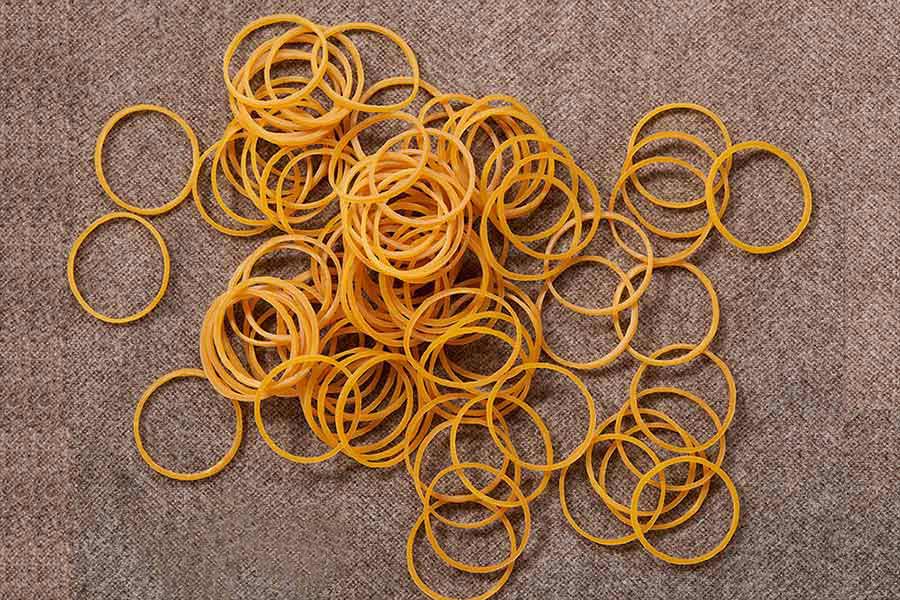
Rubber Band Materials And Why They Matter
Most rubber bands are made from either natural rubber latex or synthetic rubber compounds. Natural rubber typically offers excellent elasticity and rebound, which is why it is widely used for general-purpose bands. Synthetic rubber formulations are often used when specific resistance is needed, such as improved tolerance to oils, temperature variation, or certain storage conditions.
Material choice affects stretch feel, tensile strength, odor level, and aging behavior. A band that feels strong on day one may lose elasticity faster if the compound is not optimized or if curing is inconsistent. This is why professional rubber band production focuses on controlled compounding and curing rather than only shaping.
The Industrial Process Behind Rubber Band Manufacturing
Commercial rubber band production is generally based on producing rubber into a thin sheet or tube form, curing it to set elasticity, then cutting it into bands with controlled width and thickness. While exact machinery differs by factory setup, the production logic is consistent across most industrial lines.
The process begins with compounding, where rubber material is mixed with additives that influence elasticity, strength, color, and aging stability. The compound is then formed into a continuous shape. Many manufacturers use a sheet process where rubber is formed into a thin, uniform layer. After curing, the sheet is cut into strips, and those strips become individual rubber bands.
A key point is that cutting bands from a cured sheet or tube allows high output while keeping band dimensions consistent, which is critical for packaging operations that rely on predictable stretch and hold.
Compounding And Mixing For Consistent Elastic Performance
Before shaping, rubber must be mixed so that the material behaves consistently across a long production run. This stage affects nearly every performance outcome the buyer cares about.
A well-controlled compound helps the band stretch smoothly, recover quickly, and resist cracking. It also influences tackiness. Excess tack can make bands stick together, while too little tack can reduce grip during bundling. Color consistency also depends on mixing stability because pigments must be evenly distributed to avoid shade variation between batches.
For customers specifying color bands or performance targets, compounding control is often the difference between a band that meets spec and one that varies across shipments.
Forming The Rubber Into Sheets Or Tubes
After mixing, the compound is formed into a uniform shape. A stable thickness is important because thickness directly affects force at a given stretch level. Even a small thickness difference can change how tight the band feels when applied to the same bundle size.
In sheet-based production, rubber is calendered into a consistent thickness. In tube-based production, the rubber is extruded into a continuous tube, which will later be sliced into rings. Both methods can produce good bands when controlled properly, but each has its own process window for thickness stability and surface finish.
Curing And Vulcanization For Strength And Aging Stability
Curing sets the elastic network inside rubber. In practical terms, this is what gives a rubber band its ability to stretch and return without deforming permanently. Under-curing can produce bands that feel soft but weaken quickly. Over-curing can make bands stiff and more prone to cracking.
This stage also influences long-term storage performance. Rubber bands are often stored for months before use, especially in wholesale packaging supply chains. A stable curing profile helps preserve stretch characteristics and reduces brittle failure over time.
Cutting And Finishing For Clean Edges
Once cured, the rubber sheet or tube is cut into individual bands. Cutting quality matters because edge defects become failure points when a band is stretched. Clean cutting produces smooth edges that distribute stress more evenly.
For packaging and industrial bundling, consistent width is also important. A wider band can distribute pressure and reduce the chance of cutting into soft packaging, while a narrower band may be preferred for small bundles or stationery use.
Finishing may include dusting or surface treatment to reduce sticking during packing and use. The goal is to ensure bands separate easily in bulk bags and do not clump during handling.
Quality Parameters That Define A Good Rubber Band
Rubber band performance is usually evaluated through measurable parameters. Even when end users describe needs in simple terms like strong or durable, these needs map to specific controls in production.
| Quality Factor | What It Means In Use | What Production Controls Affect It |
|---|---|---|
| Tensile strength | Resistance to snapping | Compound quality and curing profile |
| Elastic recovery | Returns to original size | Vulcanization stability and formulation |
| Dimensional consistency | Same feel band-to-band | Thickness control and cutting accuracy |
| Aging resistance | Holds performance in storage | Cure level and material selection |
| Surface handling | Does not stick or crumble | Finishing and surface treatment |
For buyers, these parameters determine whether bands perform reliably in automated packing lines or manual bundling tasks.
How Specifications Connect To Application Needs
Rubber bands are used across many industries, so the correct band is usually defined by size and tension requirements rather than a generic type.
Bands for packaging often require predictable stretch and grip over cartons, produce packs, or bundled items. Bands for office stationery prioritize easy handling and moderate elasticity. Bands used in light industrial bundling may require thicker cross-sections for higher holding force.
In procurement conversations, terms like custom rubber bands often refer to matching width, thickness, and loop diameter to a specific bundling job. When buyers request wholesale rubber bands, they typically focus on consistent batch performance, packing format, and stable supply across repeat orders.
Why Manufacturing Control Matters For Buyers
Two rubber bands can look similar but perform differently due to compound formulation, curing stability, and cutting quality. This is why experienced buyers often request samples and performance verification under their real use conditions.
A reliable supplier should be able to support specification-based selection, provide consistent size control, and maintain stable quality across large batches. That stability reduces production interruptions and improves end-user satisfaction, especially in packaging operations where band failure causes rework.
Jinshunda supplies rubber bands for practical packaging and handling needs, with options designed for stable performance and consistent sizing. You can review our range through the rubber bands collection.
Conclusion
Rubber bands are made through controlled compounding, forming into sheets or tubes, curing to set elasticity, and precision cutting to create consistent loops. The most important performance factors, such as stretch recovery, snapping resistance, and long-term stability, depend on formulation and curing control as much as the final size. When bands are produced with stable thickness and clean edges, they perform more reliably in real packaging and handling workflows.
If you are selecting rubber bands for packaging, bundling, or bulk distribution, contact Jinshunda with your target size, tension preference, and usage scenario. We can recommend suitable options, provide sampling support, and help you choose a specification that fits your application.